
Dark Utrecht
Dark Utrecht is a location-based game you play through the city on your phone, and it's unfair at its core. You're dealt random traits, and with the wrong ones you get nowhere.
Made at the HKU for Critical Mass, a foundation that develops work that gets people reflecting on society. The theme was equality of opportunity, and the brief was to bring it close to home, corona-proof. Dark Utrecht is a hidden shadow version of the city where people come to start over: a paradise if you're lucky, a nightmare for everyone else. Your phone is the portal, and the city you already know is the game board.
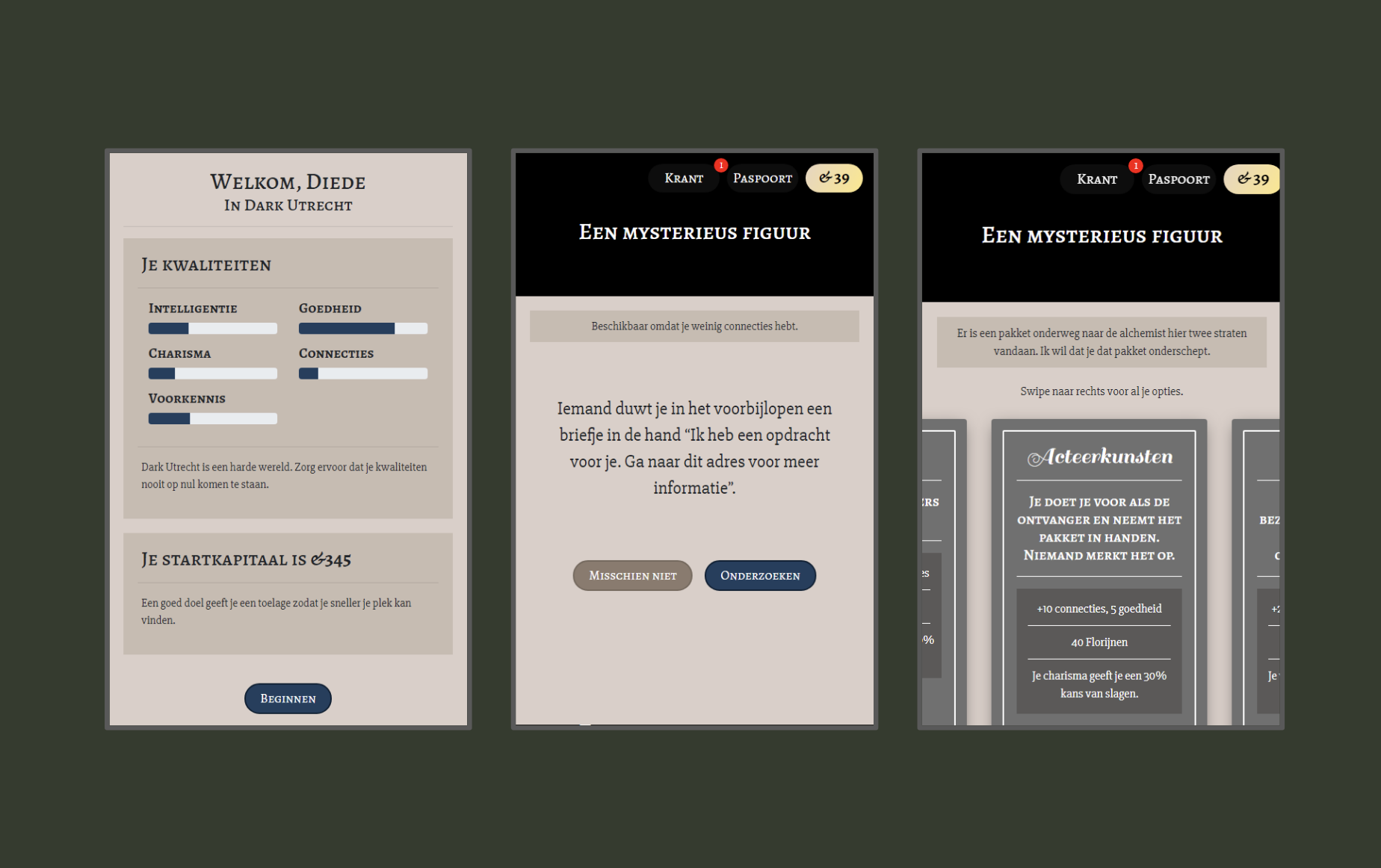
You're shown your starting position
Before you leave the house, the game shows you who you've become: your starting capital and the traits you've been dealt. Intelligence, charisma, inside knowledge, goodness, connections. They're handed out at random, and you can't change them. From that screen on, you play with what you've got.
The promise that doesn't get kept
The game welcomes you with the promise that anything is possible here and that it's all up to you. Then it turns out that getting ahead with the wrong traits barely works, no matter how well you play. The game says what society says, and keeps its word just as poorly.
The city as game board
Every location in the city yields different activities, and a shop activity is actually found at a shop. What you can do depends on where you're standing, what you own and which traits you were dealt. The texts change along too: the same place reads differently for someone with connections than for someone without.
Comparing is the mechanic
You play in a group, and through the Dark Utrecht Courant you see what's happening in the city and how the others are doing. That comparing does the real work: only when you see someone with a better starting position pull ahead on the same effort does the difference become tangible. And if you're rich enough, you can buy extra traits, which pulls the gap wider still.
Two dead ends
The first way in was the blue eyes brown eyes experiment, until further research showed why that's problematic. The second was an escape room where part of the group gets a handicap, but that form bites the message: an escape room always promises there's a way out. That's what isn't guaranteed when it comes to inequality of opportunity, so the game had to be able to end without you winning.